
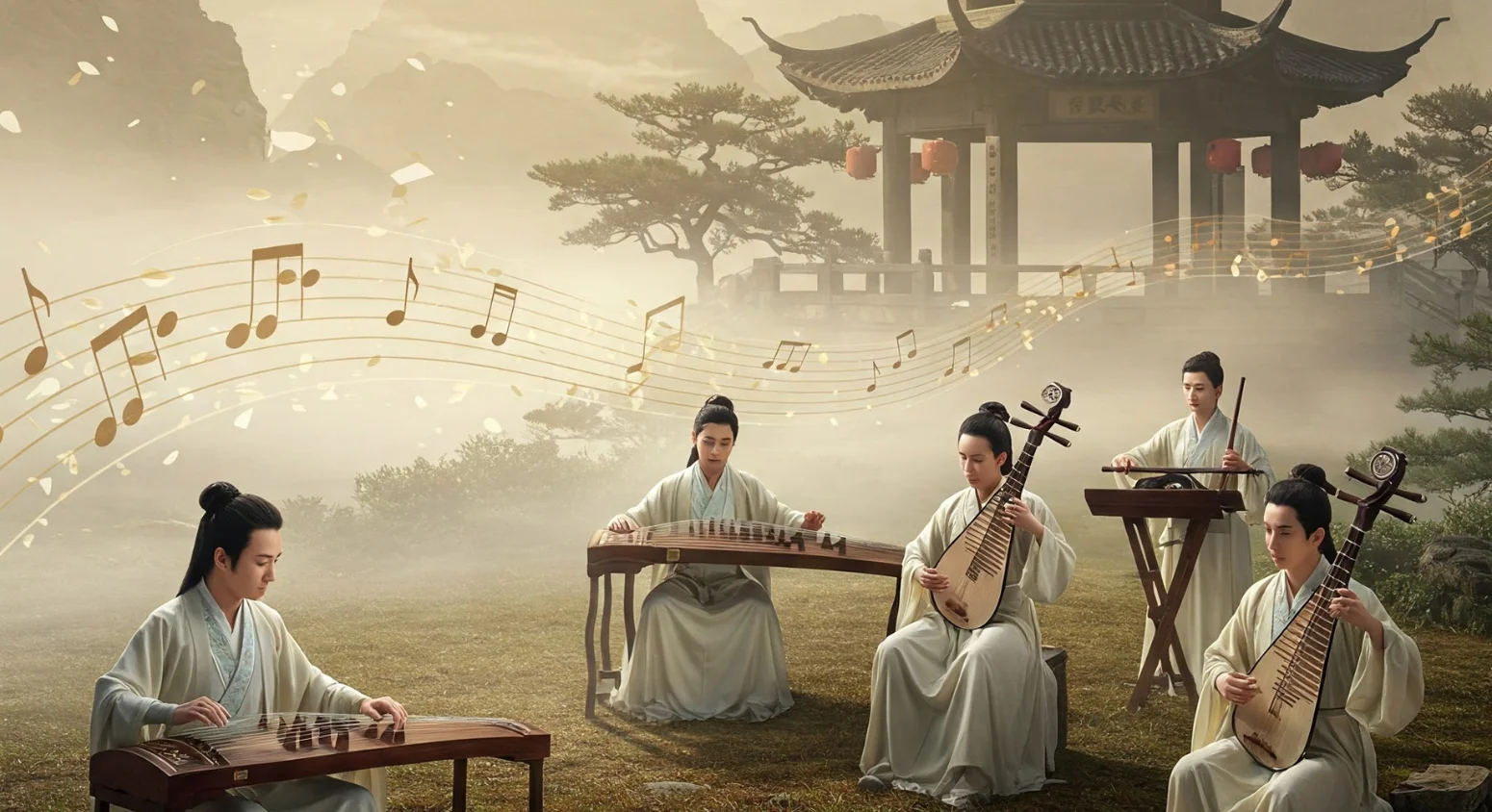
Imagine holding a flute carved from the wing bone of a crane — an instrument played 7,000 years ago in what is now central China. When archaeologists unearthed the Jiahu bone flutes in Henan Province, they didn’t just find objects. They found the oldest playable musical instruments on Earth, and proof that music has been woven into Chinese civilization since before recorded history.
The story of traditional Chinese music is not a single melody. It is a symphony that spans more than 70 centuries, shifting with every dynasty, absorbing sounds from Central Asia along the Silk Road, surviving the Cultural Revolution, and now reaching a new crescendo in the age of streaming and artificial intelligence.
Whether you’re a music student, a cultural enthusiast, or someone who stumbled upon the hauntingly beautiful sound of an erhu in a film score — this complete guide will take you through every major chapter of one of humanity’s greatest musical traditions.
Table of Contents
Quick Answer:
Traditional Chinese music has evolved over 7,000 years, from prehistoric bone flutes and ritual drums, through elaborate dynastic court music and folk traditions, to the Chinese opera of the Ming and Qing eras. Today it blends with pop, jazz, and electronic music while maintaining its pentatonic foundation and iconic instruments like the guqin, guzheng, pipa, and erhu.
What Makes Traditional Chinese Music Sound Unique? The Pentatonic Scale Explained
Traditional Chinese music is primarily built on the pentatonic (5-note) scale — gong, shang, jue, zhi, and yu — rather than the Western 7-note scale. This creates a distinctly open, meditative sound with no leading tone, fewer harmonic tensions, and a strong emphasis on melody and timbre over chord progressions.
The foundation of traditional Chinese music is the pentatonic scale (五声音阶, wǔ shēng yīn jiē) — a five-note scale that corresponds roughly to the black keys on a piano. While Western classical music uses a 12-note chromatic system and a 7-note diatonic scale, Chinese music has long privileged these five core notes, which produce a more open, flowing sound.
Beyond the scale, traditional Chinese music emphasizes:
- Timbre (音色, yīnsè) — the texture and “color” of a sound matters as much as pitch
- Melody over harmony — unlike Western orchestral music, traditional Chinese music often features a single melodic line rather than layered chords
- Microtones and ornaments — slides, bends, and trills (particularly on the erhu and guqin) that don’t exist in Western notation
- Silence as expression — rests and pauses are considered as important as the notes themselves
Traditional Chinese Music vs. Western Classical Music: Key Differences
| Feature | Traditional Chinese Music | Western Classical Music |
| Scale system | Pentatonic (5 notes) | Diatonic / chromatic (7–12 notes) |
| Harmony | Minimal; melody-focused | Rich chordal harmony |
| Notation | Tablature, cipher notation (numbered) | Staff notation (5 lines) |
| Ornamentation | Microtones, slides, bends | Trills, mordents, vibrato |
| Philosophy | Harmony with nature (Taoism, Confucianism) | Emotional expression, drama |
| Ensemble size | Small groups or solo; large for court | Full orchestras common |
| Oldest instruments | Bone flutes (~7,000 BCE) | Lyres (~3,000 BCE) |
What Are the Most Famous Traditional Chinese Musical Instruments?
Traditional Chinese instruments are classified into 8 categories called “bayin” (八音). The most widely known instruments include the guqin (7-string zither), guzheng (16–26 string zither), pipa (4-string lute), erhu (2-string bowed fiddle), dizi (bamboo transverse flute), and sheng (mouth organ) — each with a history spanning over 1,000 years.
| Instrument | Type | Era of Origin | Sound Character | Used In |
| Guqin (古琴) | 7-string zither; plucked | Zhou Dynasty (~3,000 years ago) | Deep, meditative, resonant | Scholar meditation, Confucian ritual; UNESCO-listed |
| Guzheng (古筝) | 16–26 string zither; plucked | Qin Dynasty (~2,500 years ago) | Bright, flowing, expressive | Concert performance, modern pop, film scores |
| Pipa (琵琶) | 4-string lute; plucked | Introduced via Silk Road (~2,000 years ago) | Sharp, bright, percussive | Court music, folk, battle narratives, drama |
| Erhu (二胡) | 2-string bowed fiddle | Tang/Song Dynasty (~1,000 years ago) | Mournful, human-voice-like | Folk music, Peking Opera, jazz fusion, film |
| Dizi (笛子) | Bamboo transverse flute | Neolithic period (7,000+ years) | Clear, airy, expressive | Folk music, opera, modern orchestra |
| Sheng (笙) | Free-reed mouth organ | Zhou Dynasty | Warm, organ-like, harmonic | Court music, folk ensembles; ancestor of harmonica |
| Bianzhong (编钟) | Bronze bell set; struck | Shang Dynasty (~3,600 years ago) | Rich, resonant, ceremonial | Royal ceremonies, ritual, UNESCO heritage sites |
| Xiao (箫) | Vertical bamboo flute | Han Dynasty | Breathy, soft, lyrical | Scholar music, meditation, duet with guqin |
Want to explore these instruments in depth? Read our complete guide: Top Chinese Traditional Musical Instruments — History, Sound & How to Learn
What Are the Origins of Traditional Chinese Music? (7,000 BCE – 221 BCE)
The story begins not in a palace or a court — but in a marshy wetland in what is now Henan Province, around 6,000–7,000 BCE. There, a Neolithic community called the Jiahu culture buried their dead with bone flutes carved from the wings of red-crowned cranes. When archaeologists excavated the site, they found 33 of these flutes — and some were still playable.
This discovery proves that organized musical thinking existed in China thousands of years before the earliest written records. From this ancient beginning, Chinese music evolved through three foundational periods:
Prehistoric and Xia/Shang Dynasties (7,000 BCE – 1046 BCE): Drums, Bones, and Bronze
In prehistoric China, music was inseparable from ritual and religion. Drums, bone flutes, pottery ocarinas, and bone whistles were the primary instruments. By the Shang Dynasty (1600–1046 BCE), bronze technology gave rise to the bianzhong — a set of pitched bronze bells that could play multiple notes and signify royal power. The bianzhong was more than an instrument; it was a symbol of heaven’s mandate.
Zhou Dynasty (1046–256 BCE): The Birth of Confucian Music Theory
The Zhou Dynasty established the first formal system of music in Chinese history — the yayue (雅乐), or “elegant music” — used in state ceremonies, royal banquets, and Confucian rituals. The philosopher Confucius (551–479 BCE) elevated music to a moral science, declaring that proper music cultivated virtue and social harmony. He is said to have wept upon hearing the ancient melody of Shao, finding it “perfectly beautiful and perfectly good.”
The Zhou also standardized the twelve-tone pitch system (lüshí, 律吕) — a precursor to the Western chromatic scale — and classified instruments into the Eight Sounds (bayin, 八音) based on material: silk, bamboo, wood, stone, metal, clay, gourd, and hide.
How Did Traditional Chinese Music Develop Through the Dynasties?
221 BCE – 220 CE
Qin & Han Dynasties: Imperial Music Bureau and the Silk Road Opens
Emperor Qin Shi Huang established the Imperial Music Bureau (Yuefu, 乐府) in the Qin Dynasty — the world’s first government music agency — to standardize court music and collect folk songs from conquered regions. Under Han Emperor Wudi (140–87 BCE), this bureau expanded to over 1,000 musicians. The Han period also saw the rise of xianghe songs (call-and-response vocal music with instrumental accompaniment) and the first significant contact with Central Asian music via the Silk Road, introducing instruments like the pipa and the concept of polyphonic scales.
220 – 589 CE
Three Kingdoms & Southern/Northern Dynasties: Cultural Fusion
China’s fragmentation paradoxically enriched its music. Buddhist music entered from India, folk traditions of dozens of ethnic groups merged, and the Qing Shang Music (清商乐) emerged as the dominant folk form, blending melodies from the Central Plains, the Jiangnan water regions, and northwestern frontier territories. This was the first great multicultural fusion in Chinese music history.
618 – 907 CE
Tang Dynasty: The Golden Age of Chinese Music
The Tang Dynasty is universally considered the golden age of traditional Chinese music. Chang’an (modern Xi’an), the Tang capital and eastern terminus of the Silk Road, was the most cosmopolitan city in the world — and its music reflected that. Musicians from Persia, India, Korea, Japan, and Central Asia converged, and Chinese music absorbed their scales, instruments, and rhythms.
Emperor Xuanzong (712–756 CE) was himself a musician who composed the legendary piece Nishang Yuyi Qu (Song of Rainbow Skirts and Feather Robes) and maintained a troupe of over 30,000 court musicians and dancers. The pipa became the dominant instrument of the era, and music for the first time moved out of palaces into temple fairs, teahouses, and restaurants — making music accessible to ordinary people.
960 – 1279 CE
Song Dynasty: The Rise of Popular Music and Early Opera
The Song Dynasty shifted music from royal courts to commercial urban spaces. Wazhizi (瓦子市) — entertainment districts in cities — hosted professional musicians, storytellers, and early theatrical performances. The guqin became the instrument of intellectual self-cultivation among scholars (literati), while popular song forms proliferated in teahouses and markets. Mature Chinese opera (zaju) began to take shape, combining music, poetry, acrobatics, and narrative in a total theatrical form.
1206 – 1368 CE
Yuan Dynasty: Mongol Rule and the Flourishing of Chinese Opera
Under Mongol rule, Chinese scholars were barred from government service — and channeled their talents into drama and music instead. This produced the Yuan zaju (杂剧), considered the golden age of Chinese opera. Masterworks like The Romance of the Western Chamber (Xixiang Ji) were written and performed with full musical scores. The sanxian (three-string plucked instrument) emerged as a key operatic accompaniment instrument during this period.
1368 – 1912 CE
Ming & Qing Dynasties: Regional Opera Traditions and Refinement
The Ming and Qing periods gave birth to China’s most enduring operatic traditions. The Four Great Melodies of the Ming — Haiyan, Yiyang, Yuyao, and Kunshan styles — formed the foundation of regional opera. Of these, Kunqu opera (昆曲), developed in Suzhou by musician Wei Liangfu, became the most refined, blending poetry, music, dance, and martial arts. Kunqu is now a UNESCO Masterpiece of Intangible Cultural Heritage.
By the Qing period, Peking Opera (Jingju, 京剧) emerged in Beijing as a synthesis of multiple regional styles — and quickly became China’s national opera form, with the erhu as its signature instrument. The erhu’s two strings and its mournful, voice-like timbre became synonymous with Chinese operatic emotion.
1912 – Present
Modern Era: Revolution, Repression, and Global Renaissance
The 20th century was turbulent for traditional Chinese music. In Shanghai during the 1920s–40s, the shidaiqu (时代曲) genre blended Chinese melodies with Western jazz — performed by the famous “Seven Great Singing Stars” and broadcast on radio to massive audiences. The movement was cut short when the Communist Party declared popular music “yellow music” (decadent) after 1949.
During the Cultural Revolution (1966–1976), traditional music was largely suppressed. The only approved musical form was the “Eight Model Operas” — heavily politicized revolutionary pieces. Thousands of musicians were persecuted, instruments were destroyed, and centuries of musical heritage were nearly erased.
The post-reform era (1978–present) brought a gradual renaissance. Today, traditional music is taught in conservatories, streamed globally, and blended by artists like Jay Chou (who famously incorporated guqin, erhu, and classical Chinese poetry into his Mandopop hits) and contemporary fusion ensembles like the Shanghai Chinese Orchestra.
How Does Traditional Chinese Music Influence Modern Music?
Traditional Chinese music influences modern music through instrument fusion (erhu in jazz and pop, guzheng in electronic music), the use of pentatonic melodies in film scores, the global spread of Mandopop artists who blend classical instruments with modern production, and AI tools trained on traditional compositions to generate new music.
Traditional Chinese Instruments in Modern Music
Far from museum pieces, traditional Chinese instruments are actively shaping the sound of contemporary music across genres:
- Jay Chou (周杰倫) — Taiwan’s biggest pop star built his signature sound on guqin melodies, erhu riffs, and classical Chinese poetry lyrics in hits like “青花瓷” (Blue and White Porcelain) and “東風破” (East Wind Breaks)
- Tan Dun (谭盾) — Academy Award-winning composer who used erhu, pipa, and water percussion in the Crouching Tiger, Hidden Dragon score, bringing Chinese instruments to Western film audiences
- Gao Hong — Minneapolis-based pipa virtuoso who regularly performs with jazz and Western classical musicians, demonstrating the instrument’s cross-genre versatility
- The Shanghai Chinese Orchestra — regularly collaborates with Western orchestras and commissions new works blending Chinese and Western idioms
Traditional Chinese Music in Film, Gaming, and Streaming (2025–2026)
The global spread of Chinese entertainment has created a new wave of interest in traditional music:
- Xianxia and wuxia dramas (fantasy period dramas like The Legend of Zelda-influenced Chinese productions) are reaching massive international audiences, introducing millions to guzheng and erhu soundscapes
- Video games like Black Myth: Wukong (2024–2025 global phenomenon) use traditional instruments throughout their soundtracks, generating search traffic for Chinese musical terms
- Streaming platforms — Spotify and Apple Music now have dedicated “Chinese Classical” and “Guqin Meditation” playlists with tens of millions of streams
AI and Traditional Chinese Music in 2026
Perhaps the most unexpected development in Chinese music’s 7,000-year history is the role of artificial intelligence. In 2025–2026, Chinese tech companies and universities are using AI to:
- Generate new compositions in the style of ancient guqin masters using machine learning models trained on historical scores
- Restore and reconstruct music from incomplete historical manuscripts
- Create interactive apps that teach traditional instruments using AI feedback
- Produce ambient “AI-generated Chinese traditional music” playlists for focus and meditation — a rapidly growing search category
Explore the Full World of Chinese Music
From ancient guqin to modern C-pop — discover everything on ChinaMusicSphere
What Is the Future of Traditional Chinese Music?
Traditional Chinese music enters 2026 with three powerful forces working in its favor:
1. UNESCO Recognition and Cultural Preservation
China has invested heavily in preserving its musical heritage through UNESCO’s Intangible Cultural Heritage program. Recognized traditions include Kunqu opera, guqin music, Uyghur Muqam, and Naadam festival music. These listings not only preserve the traditions but generate international educational interest and tourism.
2. Global Chinese Diaspora and Cultural Soft Power
With over 50 million ethnic Chinese living outside China, traditional music serves as a cultural bridge. Community schools in cities from San Francisco to London to Sydney teach guzheng and erhu, while Chinese New Year celebrations worldwide feature live traditional performances. Chinese cultural soft power initiatives have funded traditional music festivals in over 40 countries.
3. The Gen Z and Millennial Renaissance
Contrary to fears that young people are abandoning traditional music, there’s a measurable revival. On Chinese social media platforms like Douyin (TikTok’s Chinese version) and Bilibili, guqin, guzheng, and erhu cover videos regularly go viral, with some creators amassing tens of millions of followers. The hashtag #古风音乐 (Ancient Style Music) has billions of views, blending traditional aesthetics with modern pop production.
In Closing
Traditional Chinese music stands as one of the world’s oldest living musical traditions — over 7,000 years old — yet it continues to evolve with remarkable vitality. Rooted in a distinctive pentatonic foundation and a deep emphasis on timbre, texture, and expressive nuance, it differs fundamentally from Western musical systems. Across centuries, every major Chinese dynasty enriched the tradition with new instruments, performance styles, and philosophical depth, shaping a cultural legacy that is both layered and dynamic.
Despite facing near devastation during the Cultural Revolution, traditional Chinese music survived — and its revival is a powerful testament to cultural resilience. Today, rather than being threatened by modernization, the tradition is expanding through fusion genres, digital platforms, streaming services, and even AI-driven experimentation. What once echoed in imperial courts and folk villages now resonates globally, proving that tradition and innovation can coexist — and even strengthen one another.
Frequently Asked Questions
What is the oldest traditional Chinese musical instrument?
The Jiahu bone flutes, discovered in Henan Province, are the oldest known Chinese musical instruments — dating back approximately 6,000–7,000 years (around 5000–6000 BCE). They were carved from the wing bones of red-crowned cranes and were functional musical instruments, not just ceremonial objects. Several are still playable today and are housed in the Henan Museum.
What is the pentatonic scale and why is it central to Chinese music?
The pentatonic scale (五声音阶, wǔ shēng yīn jiē) uses five notes per octave rather than the seven notes of Western scales. In Chinese music, these five tones correspond to the five elements (wood, fire, earth, metal, water) and five virtues in Confucian philosophy. The pentatonic scale creates the characteristic open, melodic, and meditative sound associated with traditional Chinese music. It’s also more universal — you’ll find pentatonic scales in African, Celtic, and Native American music traditions as well.
How is traditional Chinese music different from Western classical music?
The key differences are:
(1) Scale — Chinese music uses a 5-note pentatonic scale vs. the Western 7-note diatonic scale;
(2) Harmony — Chinese music prioritizes melody and timbre over chordal harmony;
(3) Philosophy — Chinese music is connected to Taoist and Confucian ideas of cosmic balance, while Western music focuses on emotional drama and formal structure;
(4) Notation — Chinese music traditionally used tablature or cipher notation, not the Western staff;
(5) Ornamentation — Chinese instruments use microtones, bends, and slides that don’t exist in Western musical notation.
What is Peking Opera and how is it related to traditional Chinese music?
Peking Opera (Jingju, 京剧) is a comprehensive performing art combining music, vocal performance, mime, dance, and acrobatics. It emerged in Beijing during the late Qing Dynasty (late 18th–19th century) as a synthesis of regional opera styles. Its musical foundation uses the erhu as the primary melodic instrument, accompanied by percussion (drums, gongs, cymbals), plucked strings (pipa, sanxian), and wind instruments (suona). Peking Opera uses a highly stylized vocal style with specific notation for each character type (sheng, dan, jing, chou).
Which Chinese musical traditions are recognized by UNESCO?
UNESCO has recognized several Chinese musical traditions as Intangible Cultural Heritage, including: Kunqu opera (2001, one of the first UNESCO Masterpieces), guqin music (2003), Uyghur Muqam of Xinjiang (2005), Mongolian music including Urtiin Duu and Khoomei throat singing, Cantonese opera (2009), and various regional folk music traditions. China has the second-largest number of UNESCO Intangible Cultural Heritage inscriptions in the world.
What modern artists blend traditional Chinese music with contemporary styles?
Notable artists include: Jay Chou (Mandopop with guqin/erhu elements), Tan Dun (film composer, Oscar winner for Crouching Tiger), Wang Leehom (chinked-out hip-hop with traditional instruments), Hú Yanbin (indie rock with erhu), and the Shanghai Chinese Orchestra (classical-crossover ensemble). International artists like Yo-Yo Ma have also recorded Chinese folk music, and Western composers like John Adams have incorporated Chinese musical elements.
How did the Cultural Revolution affect traditional Chinese music?
The Cultural Revolution (1966–1976) was devastating for traditional Chinese music. The Red Guards destroyed instruments, burned musical scores, and persecuted musicians and scholars. Traditional music was labeled “feudal” or “bourgeois” and banned. Only eight politically approved “Model Operas” (样板戏) were permitted. Despite this, many musicians secretly preserved their skills and knowledge. After Mao’s death in 1976 and Deng Xiaoping’s reforms, traditional music began a slow recovery that continues through the present day.
Where can I listen to traditional Chinese music online in 2026?
Traditional Chinese music is widely available on: Spotify (search “Chinese classical music,” “guqin meditation,” or “guzheng relaxing”); Apple Music (dedicated Chinese Classical genre section); YouTube (channels like 古琴Guqin have millions of subscribers); NetEase Cloud Music (网易云音乐) for the most comprehensive Chinese music catalog; and QQ Music for Chinese classical and folk archives. For learning, look for bilingual guzheng or erhu tutorial channels on YouTube that explain the music’s cultural context.