
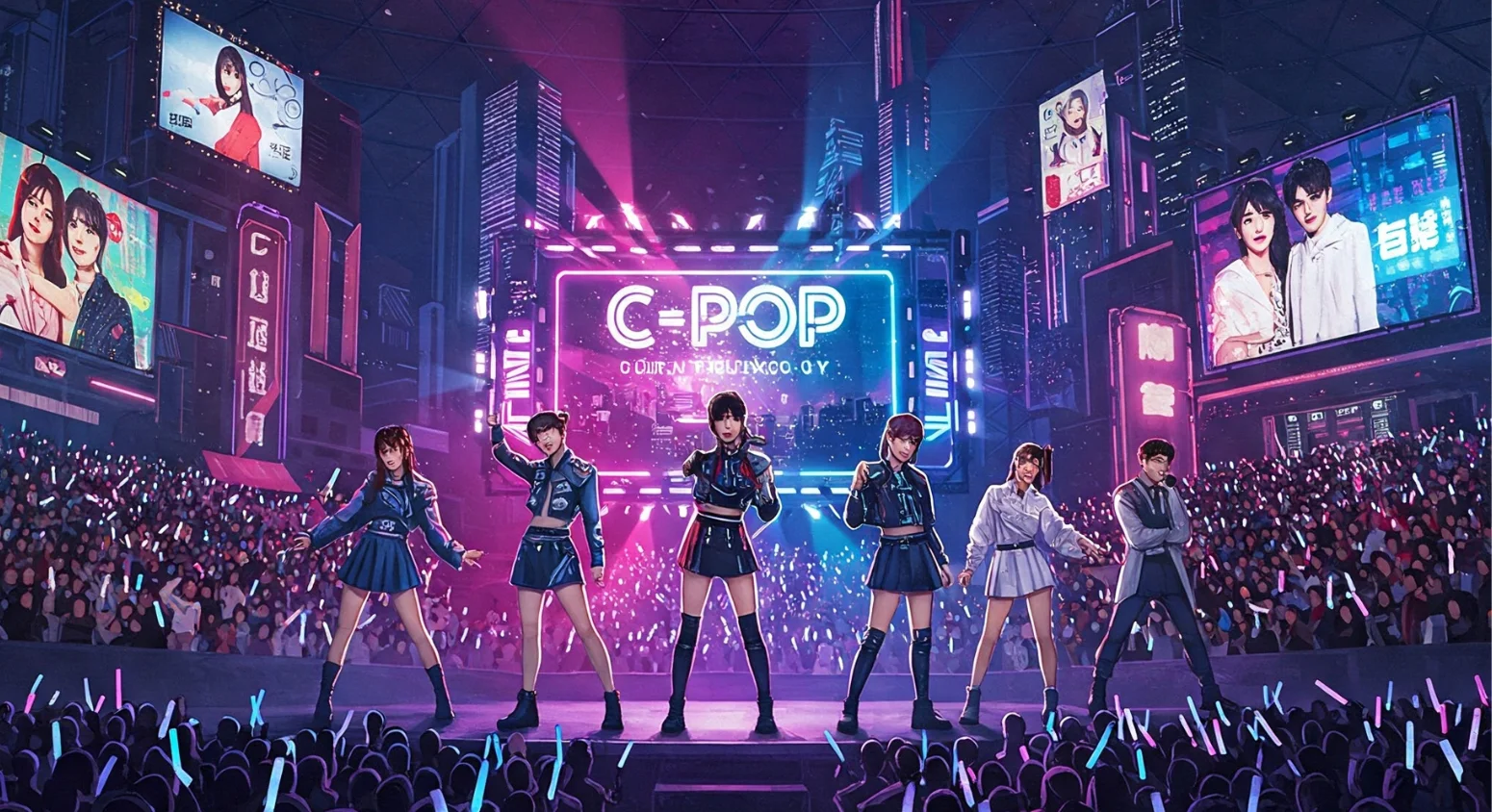
Heard a C-pop song on TikTok, in a drama, or on a playlist — and want to understand what it actually is? You’re in the right place. Millions of people outside China are discovering Chinese pop music for the first time in 2026, and the genre is more accessible than ever. This guide covers everything: what C-pop means, how it started, its main styles, the biggest artists right now, and exactly how it compares to K-pop and J-pop.
Table of Contents
Quick Answer:
C-pop (Chinese pop music) is an umbrella term for popular music from Chinese-speaking regions, sung mainly in Mandarin or Cantonese. It includes subgenres like Mandopop, Cantopop, and Zhongguo Feng. As of 2026, C-pop is going global — Jackson Wang topped Apple Music in 20+ countries in 2025, and Chinese artists are charting on Billboard for the first time. From classic legends like Jay Chou to modern stars like G.E.M. and Lexie Liu, here’s everything you need to know.
What Is C-Pop?
C-pop is short for Chinese pop music. It is an umbrella term for popular music created in Chinese-speaking regions — including Mainland China, Taiwan, Hong Kong, and Chinese diaspora communities worldwide — sung primarily in Mandarin, Cantonese, or other Chinese dialects.
C-pop is not one single sound. It covers ballads, R&B, hip-hop, dance-pop, and even experimental music — as long as it’s rooted in Chinese language and culture. The genre is defined less by a specific beat and more by its storytelling tradition: C-pop lyrics tend to focus on emotion, personal experience, and poetic imagery.
Think of C-pop the same way you’d think of ‘pop music’ in general — it’s a broad genre label that covers many styles under one cultural identity.
What Are the Main Types of C-Pop?
C-pop breaks down into several subgenres based on language, region, and style. Here are the most important ones:
| Subgenre | Language | Origin | Known For |
| Mandopop | Mandarin | Taiwan, Mainland China | Emotional ballads, singer-songwriters, love lyrics |
| Cantopop | Cantonese | Hong Kong | Catchy hooks, drama soundtracks, iconic 80s-90s era |
| Hokkien Pop | Hokkien/Taiwanese | Taiwan, SE Asia | Folk-influenced, regional identity, nostalgic feel |
| Zhongguo Feng | Mandarin | Mainland China | Traditional Chinese instruments + modern pop production |
| C-pop Hip-Hop | Mandarin/mixed | Mainland China | Street culture, rap, driven by shows like ‘The Rap of China’ |
Mandopop
Mandopop is the most widely heard form of C-pop today. It’s sung in Mandarin and dominates charts across Mainland China, Taiwan, and Chinese-speaking communities in Southeast Asia. Ballads are central to Mandopop — artists like Jay Chou, JJ Lin, and G.E.M. built entire careers on melodic, emotionally resonant songs.
Cantopop
Cantopop emerged from Hong Kong and had its golden era in the 1980s and 1990s. Stars like Jacky Cheung, Anita Mui, and Leslie Cheung defined the genre. Cantopop was closely tied to Hong Kong cinema and television, giving it a distinct dramatic flair and storytelling style.
Zhongguo Feng (Chinese Style Music)
Zhongguo Feng (中国风, literally ‘Chinese style’) is a subgenre that blends modern pop production with traditional Chinese instruments — erhu, guzheng, dizi — and classical or semi-classical lyrics. Jay Chou is the most famous creator of this style. In 2025-2026, Zhongguo Feng is seeing a major revival, especially among younger fans who want a distinctly Chinese sound.
How Did C-Pop Start? A Brief History
| Era | What Happened |
| 1920s-1940s | Shidaiqu (时代曲) — the earliest Chinese pop — emerged in Shanghai, blending Western jazz with Chinese folk melodies. |
| 1950s-1970s | Teresa Teng pioneered emotional Mandarin ballads and became the first Chinese pop icon across Asia. |
| 1980s-1990s | Cantopop’s golden age in Hong Kong; Jacky Cheung, Leslie Cheung, Anita Mui became regional superstars. |
| 2000s | Jay Chou redefines Mandopop, fusing R&B, hip-hop, classical, and Chinese folk. Taiwan becomes the creative hub of C-pop. |
| 2010s | Idol groups rise (modelled after K-pop); streaming platforms like NetEase and Tencent Music reshape distribution; global reach begins. |
| 2020s-2026 | C-pop goes global: Jackson Wang, Lexie Liu, Lay Zhang reach international charts; Zhongguo Feng revival; AI-generated music emerges in China. |
C-pop’s evolution reflects China’s broader cultural opening — from regional folk traditions to a globally streamed industry. What makes C-pop’s history unique is that it never lost its emphasis on melody and lyrical meaning, even as it absorbed Western influences.
Who Are the Most Famous C-Pop Artists?
| Artist | Known For | Key Genre |
| Teresa Teng | Emotional ballads that defined Asian pop from the 1960s-80s; her songs still charted after her death. | Mandopop |
| Jay Chou | Inventor of Zhongguo Feng; most influential Mandopop artist of the 2000s; still topping charts in 2025. | Mandopop / Zhongguo Feng |
| Jacky Cheung | The ‘God of Songs’; over 25 million records sold; voice of Cantopop’s golden era. | Cantopop |
| Leslie Cheung | Cultural icon in music and film; redefined masculine performance in Cantopop. | Cantopop |
| Anita Mui | The ‘Madonna of Asia’; pioneered bold visuals and performance in Cantopop. | Cantopop |
| Wang Leehom | Pioneer of Chinese fusion music; merged R&B, hip-hop with traditional Chinese music. | Mandopop / Fusion |
Modern Stars (2010s-Present)
| Artist | Known For | Why They Matter Now |
| G.E.M. (Gloria Tang) | Powerful vocals; viral ‘I Am A Singer’ moment; consistent global chart presence. | One of C-pop’s biggest female voices internationally. |
| JJ Lin | Emotional ballads; over 20 years of consistent hits; beloved in Singapore and beyond. | Represents the classic Mandopop sound, still evolving. |
| Jolin Tsai | ‘Queen of C-Pop’; dance-pop, bold visuals, LGBTQ+ advocacy. | Cultural icon and commercial powerhouse. |
| Jackson Wang | Founder of TEAM WANG; topped Apple Music in 20+ countries in 2025; broke Billboard 200 record for solo Chinese artists. | The biggest C-pop global crossover story of 2025. |
| Lexie Liu | Genre-blending R&B/electronic/pop; multilingual artist with international buzz. | Represents the future of C-pop’s sound. |
| Lay Zhang (Xiumin) | EXO member gone solo; strong China domestic market; actor + producer. | Crossover C-pop/K-pop appeal. |
Rising Voices in 2025-2026
| Artist | Why They’re Trending |
| Hua Chenyu | NetEase 2025 Artist of the Year; powerful original compositions; massive domestic following. |
| Zi Yu | Only Chinese artist on the 2025 Billboard Global chart; actor-turned-singer breaking through internationally. |
| Xiao Zhan | Viral drama appearances drive music streaming numbers; strong social media fandom. |
| Liu Yuxin | Modern genre-blending style; appeal to younger global audiences. |
Why Is C-Pop Going Global in 2025-2026?
Five years ago, C-pop was considered regional. In 2026, it’s a genuine global force. Here’s why:
1. Streaming made it frictionless. Spotify, Apple Music, and YouTube Music now carry deep C-pop catalogues. You no longer need to know where to look.
2. TikTok virality. C-pop hooks — especially from Chinese drama OSTs — spread globally without language barriers. A song can go viral in Brazil or Germany before it’s even charted in China.
3. Chinese drama (C-drama) crossover. Shows like ‘The Untamed,’ ‘Word of Honor,’ and ‘Hidden Love’ have massive international fanbases, and their soundtracks introduce new listeners to C-pop daily.
4. Record-breaking chart moments. Jackson Wang’s 2025 Billboard 200 record and Zi Yu’s Billboard Global chart placement are milestone moments that legitimized C-pop in Western music media.
5. The Chinese diaspora effect. Over 50 million overseas Chinese create a built-in global audience — and their social media activity spreads C-pop content far beyond that core demographic.
C-Pop vs K-Pop vs J-Pop: What’s the Difference?
| Aspect | C-Pop (Chinese Pop) | K-Pop (Korean Pop) | J-Pop (Japanese Pop) |
| Primary Languages | Mandarin, Cantonese, regional dialects | Korean | Japanese |
| Core Identity | Melody, lyrical emotion, storytelling | Performance, choreography, visual identity | Individuality, genre diversity, sonic craftsmanship |
| Artist Type | Singer-songwriters + pop stars + idol groups | Highly structured idol groups + solo artists | Solo artists, bands, anime tie-ins |
| Industry Model | Platform-driven (NetEase, Tencent) + indie | Agency training system (SM, HYBE, YG, JYP) | Relatively domestic-focused, label-controlled |
| Global Fandom | Fast-growing; strongest in Asia + diaspora | Largest organized global fandom system (fandoms like ARMY) | Strong in Japan; selective global impact |
| Typical Sound | Ballads, R&B, hip-hop, Zhongguo Feng | EDM-pop, hip-hop, powerful choreography-ready beats | Pop-rock, anime tie-in songs, experimental |
| 2026 Momentum | Rapidly expanding globally; new chart records | Established global force; some market saturation | Stable domestic market; selective global moments |
The key difference: C-pop is defined by its language and cultural roots, not a single industry formula. Unlike K-pop, which has a recognizable visual and structural template, C-pop is far more musically diverse — you can find everything from ancient-style folk pop to underground hip-hop under the same label.
Explore: C-Pop vs K-Pop
What Is Zhongguo Feng?
Zhongguo Feng (中国风, ‘Chinese style’) is a C-pop subgenre that combines modern pop production with traditional Chinese musical elements — including instruments like the erhu, guzheng, and pipa — and lyrics drawn from classical poetry or historical themes.
Jay Chou is the defining Zhongguo Feng artist — songs like 菊花台 (Chrysanthemum Terrace) and 青花瓷 (Blue and White Porcelain) brought ancient imagery into mainstream pop. In 2025-2026, the style is experiencing a revival as younger Chinese artists and fans reclaim traditional culture in a modern context. If you’ve heard a C-pop song that sounds cinematic, ancient, or distinctly ‘Chinese’ in atmosphere, you’ve almost certainly heard Zhongguo Feng.
How to Start Listening to C-Pop (5-Step Beginner Guide)
New to C-pop and not sure where to begin? Follow these steps:
- Start with one artist that matches what you already like. Into emotional ballads? Try Jay Chou or JJ Lin. Into dance-pop? Start with Jolin Tsai. Into something global and energetic? Jackson Wang is your entry point.
- Pick a gateway album or playlist. Search ‘C-pop essentials’ on Spotify or Apple Music. These curated playlists are specifically designed for new listeners and cover the key genres.
- Follow a Chinese drama. Chinese dramas (C-dramas) are one of the best ways into C-pop because you discover music in emotional context. Start with ‘The Untamed,’ ‘Hidden Love,’ or ‘Word of Honor’ on Netflix or Viki.
- Don’t worry about the language. C-pop’s emotional core is in the melody. Many long-term fans don’t speak Mandarin — the music communicates emotion directly. Translations are widely available on fan sites.
- Explore subgenres once you have a foundation. Once you’ve found 3-5 songs you love, explore: if you like ballads, go deeper into Mandopop; if you like the ancient-feeling sound, explore Zhongguo Feng; if you like hip-hop, search ‘The Rap of China’ artists.
Where to Stream C-Pop Outside China
| Platform | C-Pop Availability | Best For |
| Spotify | Excellent — most major C-pop artists and curated playlists available globally | Best starting point for international listeners |
| Apple Music | Excellent — C-pop Song Dynasty playlist updated regularly; strong catalogue | Best for chart tracking and new releases |
| YouTube Music | Very good — many music videos and lyric videos; free tier available | Best for visual experience and discovery via videos |
| NetEase Cloud Music | The largest C-pop catalogue in existence; available globally with VPN or international app | Best for deep catalogue, indie artists, and fan communities |
| Tencent Music (QQ Music) | Comprehensive Chinese catalogue; international access limited | Best for current China domestic charts |
| YouTube | Huge free resource; most major MVs and live performances available | Best for free listening and discovering artists via drama OSTs |
C-Pop in 2025-2026: What Changed?
C-pop in 2026 is not the same genre it was even three years ago. Here are the key developments:
- Jackson Wang’s Billboard record: In 2025, Jackson Wang topped Apple Music charts in over 20 countries with his album MAGICMAN 2, breaking the record for solo Chinese artists on the Billboard 200. His sold-out global MAGICMAN World Tour marked a turning point for C-pop’s international commercial viability.
- Zi Yu goes global: The 23-year-old actor-turned-singer became the only Chinese artist to make the 2025 Billboard Global chart, signalling a new generation of crossover artists.
- Hua Chenyu dominates domestic streaming: Named NetEase’s 2025 Artist of the Year, Hua Chenyu represents the powerful domestic streaming ecosystem that now rivals any global platform in scale.
- AI-generated music emerges: In 2025, AI-generated tracks became a notable part of China’s music landscape — acknowledged by industry outlets and music curators. This is a trend to watch in 2026.
- Zhongguo Feng revival: Traditional Chinese style music has seen renewed interest among younger fans, driven by historical drama OSTs and national cultural pride movements online.
- Jay Chou remains the king: Despite 20+ years in the industry, Jay Chou continued to dominate Mandopop charts across Spotify, Apple Music, and Tencent Music throughout 2025.
Conclusion
C-pop in 2026 is no longer a niche interest — it’s a global music movement with chart-topping moments, sold-out world tours, and tens of millions of international fans. Whether you’re drawn in by a Jay Chou ballad, a Jackson Wang anthem, or a Chinese drama OST that won’t leave your head, you’re now part of the biggest musical story coming out of Asia.
You don’t need to speak Mandarin to feel C-pop. You just need to press play.
Frequently Asked Questions
What is C-pop music?
C-pop stands for Chinese pop music. It is an umbrella term for popular music created in Chinese-speaking regions — including Mainland China, Taiwan, Hong Kong, and Chinese communities worldwide — sung primarily in Mandarin, Cantonese, or other Chinese dialects. C-pop includes many subgenres such as Mandopop, Cantopop, Zhongguo Feng, and C-pop hip-hop.
What is the difference between C-pop and Mandopop?
C-pop is the broad umbrella term for all Chinese pop music. Mandopop is a specific subgenre of C-pop sung in Mandarin — the most widely spoken form. All Mandopop is C-pop, but not all C-pop is Mandopop. C-pop also includes Cantopop (Cantonese), Hokkien pop, and Zhongguo Feng.
Who is the most famous C-pop singer?
Jay Chou is widely considered the most influential C-pop artist of all time, having shaped Mandopop and Zhongguo Feng since 2000 and continuing to top charts in 2025. Teresa Teng is the most iconic historical figure. Among current global crossover artists, Jackson Wang is the most internationally recognized C-pop star as of 2026.
How is C-pop different from K-pop?
C-pop focuses primarily on melody, lyrics, and emotional storytelling. K-pop is defined by a highly structured idol training system, strong choreography, and a unified visual identity. C-pop is musically more diverse and includes everything from solo singer-songwriters to idol groups, whereas K-pop centers heavily on group performance and fandom management.
Is C-pop popular outside China?
Yes — and increasingly so. As of 2025-2026, C-pop artists like Jackson Wang are charting globally, touring internationally, and topping streaming charts in countries far beyond Asia. Chinese drama OSTs spread C-pop music virally on TikTok and YouTube worldwide. The genre has a fast-growing international fanbase, particularly in Southeast Asia, Europe, and the Americas.
What is Zhongguo Feng?
Zhongguo Feng (中国风) means ‘Chinese style’ and refers to a C-pop subgenre that combines modern pop production with traditional Chinese instruments — like the erhu, guzheng, and pipa — and lyrics inspired by classical poetry or Chinese history. Jay Chou is the most famous creator of this style, and it is experiencing a significant revival in 2025-2026.
Where can I listen to C-pop outside China?
The best platforms for C-pop outside China are Spotify, Apple Music, and YouTube. Spotify has extensive C-pop playlists and most major artists. Apple Music curates a regularly updated ‘C-pop Song Dynasty’ playlist. For the deepest catalogue including indie and lesser-known artists, NetEase Cloud Music has an international version available in many countries.
What language is C-pop sung in?
C-pop is sung primarily in Mandarin Chinese (in Mandopop) or Cantonese (in Cantopop). Some C-pop also includes songs in Hokkien, Hakka, or other regional Chinese dialects. A growing number of C-pop artists — especially those targeting global audiences — release songs partially or fully in English, such as Jackson Wang and Lexie Liu.
Do I need to understand Chinese to enjoy C-pop?
No. Many C-pop fans worldwide don’t speak Mandarin or Cantonese. C-pop’s strength is its emotional melody — the music communicates feeling regardless of language. English translations of lyrics are widely available on fan sites and apps like Musixmatch. Starting with the music and exploring lyrics later is a completely valid — and common — approach.
What is the biggest C-pop song right now in 2026?
Chart positions change rapidly, but as of early 2026, Jackson Wang’s tracks from MAGICMAN 2 remain among the most-streamed C-pop songs internationally. Jay Chou continues to dominate Mandopop streams on Tencent and Spotify. For real-time rankings, check Spotify’s ‘C-pop Song Dynasty’ playlist or Apple Music’s Chinese pop charts, which are updated weekly.